


PEACE AS A MISSION: THE ROLE OF DEFENSE IN THE NATIONAL RECONSTRUTION OF TIMOR-LESTE
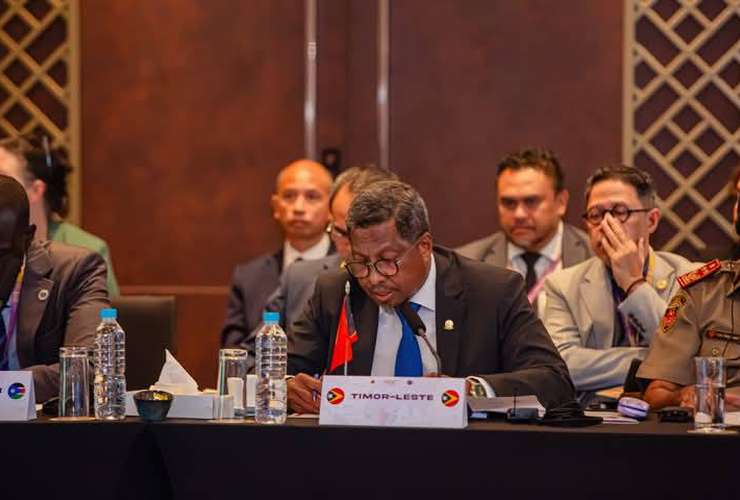
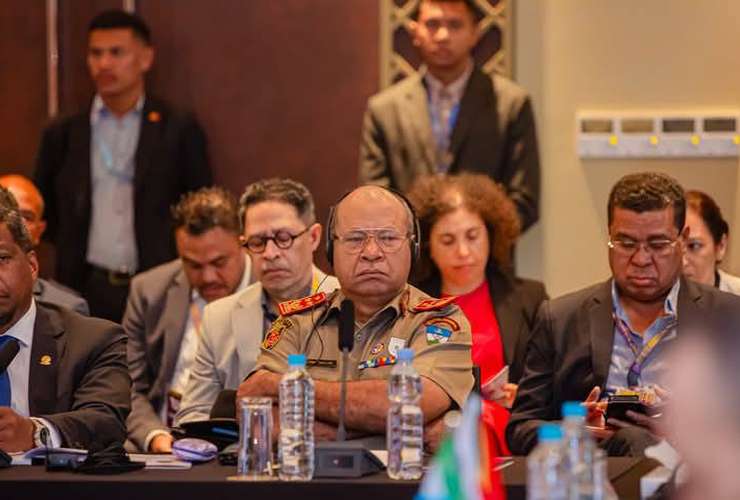
His excellency Prime-Minister, Kay Rala Xanana Gusmão
Mr. Secretary-General of the g7+, Dr. Helder da Costa
Excellence’s Ministers and heads of delegation,
Distinguished guests,
Ladies and Gentlemen,
It is with a deep sense of honor and responsibility that I take
part in this ministerial meeting of the g7+, here in our capital, Dili, a city
that, 25 years ago, rose from the ashes, amid rubble and hope.
I would like to thanks to the ministers, Bendito Freitas and
Kenyeh Barley, for the invitation extended to me and, above all, to commend the
inspiring theme of this session – “From Ashes to Peace and Stability:
Timor-Leste’s Journey of Transformation”. This is undoubtedly a narrative
that makes us proud and that we are eager to share with our sister countries in
the g7+.
When we speak of Timor-Leste’s journey, we are referring to a
people who, in 1999, found their country completely devastated: 70% of
infrastructure was destroyed; the public administration had collapsed; the
armed forces had yet to be formally constituted; and the social fabric was
deeply wounded. In truth, there was such a profound institutional vacuum that
it threated to plunge our country into chaos.
It was in this context that we began a difficult and complex
journey, made possible only through the visionary leadership embodied by Xanana
Gusmão and the other founders of our nation. They inspired us to transform pain
into hope, destruction into reconstruction, and resentment into reconciliation.
They also taught us that our true enemies were, and still are,
backwardness, poverty, and disunity, which we must fight with the same courage
and selflessness that we showed during 24 years of resistance and our struggle
for independence. Yet, to follow the
arduous path ahead, then and now, the courage and resilience of our people, the
support of the international community, and the creation of solid and
legitimate institutions have also been essential.
Among those institutions, allow me to highlight the one for
which I currently hold direct political responsibility: national defense.
The Timor-Leste defense force (F-FDTL) was born from the
resistance and adapted to the demanding reality of peace. It was established in
2001 with the mission to guarantee sovereignty, protect the people, and
contribute to internal stability. But more than just a military force, the
F-FDTL became a symbol of national unity, discipline, and public service. For this
reason, it is a source of pride for the Timorese people and for our democratic
state governed by the rule of law.
From the early years of our independence, the defense sector
has had a mission that goes far beyond the military component. Indeed, it
played a central role in the peacebuilding efforts, particularly in the
demobilization and reintegration of former combatants, in support of internal
security in coordination with the national police, especially during critical moments
such as the 2006 crisis, and in emergency missions to assist populations
affected by natural disasters.
The F-FDTL has stood, and continues to stand, alongside the people,
whom it serves with loyalty and dedication, because its mission is to safeguard
the dignity of the nation and to be where the Timorese people most need them. That
is why it has participated in the reconstruction of villages, in vaccination
campaigns, in forest protection, in food transportation, and even in the civic
education of youth.
I especially value this last aspect, because peace becomes
stronger when it is taught, and young people learn that: serving the nation
is an honor and that freedom must be protected with responsibility. At a
time when many of our g7+ countries are facing the challenges of post-conflict transition,
institutional fragility, or the rebuilding of their armed forces, I believe the
experience of Timor-Leste can be useful.
Our journey shows that stability is born from legitimacy. That
peace is not merely the absence of war, but the presence of solid, inclusive
institutions in the service of the common good. It also shows that defense can
and must be part of the solution, when it serves the people, respects civilian authority,
and integrates the culture of peace and cooperation.
In the context of g7+, where so many countries share
experiences of conflict, reconstruction, and development, Timor-Leste stands as
an example of resilience, but also of continuous learning.
Today, our defense forces are engaged in multiple missions,
operating within the framework of democratic legality and under the authority
of elected leadership. They continue to be, for many Timorese, one of the most
trusted institutions. This is not trust that arises by chance: it is built
day by day, through hard work, ethics, and dedication.
Timor-Leste’s experience shows that the defense sector can
and should be a transforming agent in society. Investment in the F-FDTL is not
measured merely in equipment or infrastructure, but above all in its ability to
generate trust, foster leadership, and ensure social cohesion. Today’s Timorese
soldier is often also an educator, a social mediator, a support to local
authorities, an active agent in environmental protection and disaster response
he or she embodies values of courage, discipline, solidarity, and commitment to
the common good.
In recent years, we have sought to deepen this multifaceted vocation
od defense. We are working to ensure the F-FDTL becomes a modern force, capable
of addressing contemporary risks and threats, from climate change to cybersecurity,
from natural resource protection to participation in international missions. At
the same time, we want it to remain a school of citizenship, a reference point
for our youth, and an essential pillar of national identity.
We know this is an ambitious goal, but it is a fair and
necessary one for three key reasons. First, peace is built not only with
speeches or treaties, but with solid institutions and concrete actions on the
ground. Second, sovereignty is not just a legal principle, but a daily
practice of dignity and responsibility. Third, sustainable development
is only possible when there is human security, when every citizen feels that
their life, rights, and future are protected.
Timor-Leste is committed to global peace. That is why we seek
to contribute to conflict resolution through inclusive dialogue and diplomacy. And
it is based on this vision that our country reaffirms its willingness to
support multilateral peace promotion initiatives and negotiated solutions in
crisis contexts.
To this end, our foreign policy is guided by principles of
international legality, mutual respect, and cooperation among all peoples. Regardless
of geostrategic alignments. This is a firm position of the IX Constitutional
Government, as we believe this is the only way to build a truly cooperative and
balanced international order, ones free from truly cooperative and balanced
international order, ones free from geopolitical pressures and divisions driven
by multipolarity. It is in this context that Timor-Leste contributes an
international system that is increasingly fair and inclusive, in the
multilateral pursuit of the best solutions for economic, social, cultural,
scientific, and technological development – and for defense and security.
Our commitment to global peace, international legality,
mutual respect, cooperation among peoples, and multilateralism is inseparable
from our historical journey, from our identity as a free and sovereign nation,
and from the way we have protected and managed our natural resources. Therefore,
we advocate that the petroleum and natural gas from the greater sunrise field
must be extracted and utilized by Timor-Leste to boost sectors such as health,
education, agriculture, transport, and communications, so as to meet the basic
and essential needs of national development.
Therefore, we reaffirm our readiness to cooperative with our
sister countries in the g7+ through joint training initiatives, exchange of
good practices, institutional capacity building, and support for the rebuilding
of security and defense capabilities. Our commitment is to peace, a lasting,
inclusive, and people-centered peace.
Allow me to conclude with a thought that has accompanied us
since the beginning of our nation-building journey: Timor-Leste born from struggle,
Timor-Leste survived through the fait of its people, and Timor-Leste lives
today through the power of peace. May that peace be the legacy we
leave to future generations.
Thank you very much!